2026-01-15 06/08/2024
The partner#
In 2024, we collaborated with researchers at DuocUC, a leading higher education institution in Chile. The project was led by Felipe Rivera, Head of Academic Quality Evaluation and Javiera Cienfuegos, a Senior Researcher at DuocUC and they focused on understanding and improving the educational landscape for women in technical and professional fields.
The challenge#
DuocUC needed to conduct a qualitative, explorative evaluation of the gender gaps faced by women pursuing STEM (Science, Technology, Engineering, and Mathematics) careers at the university.
Traditional qualitative methods often struggle to scale while maintaining the depth required to uncover complex social issues. The team needed a way to collect authentic, personal narratives from a large group of students and then rigorously analyse that data to understand the underlying causal drivers of gender discrimination.
The Causal Map solution#
We deployed our "Seamless Stories" workflow—an end-to-end, AI-supported process that combines QualiaInterviews for data collection and Causal Map for systematic analysis. This approach allowed the university to move from research questions to high-quality visual maps much faster than traditional manual coding, without sacrificing the nuance of the students’ lived experiences.
Our approach#
We had a first meeting to understand what they wanted to find out, their research questions and the scope of the study and to determine the domains in which the interviews would be conducted.
-
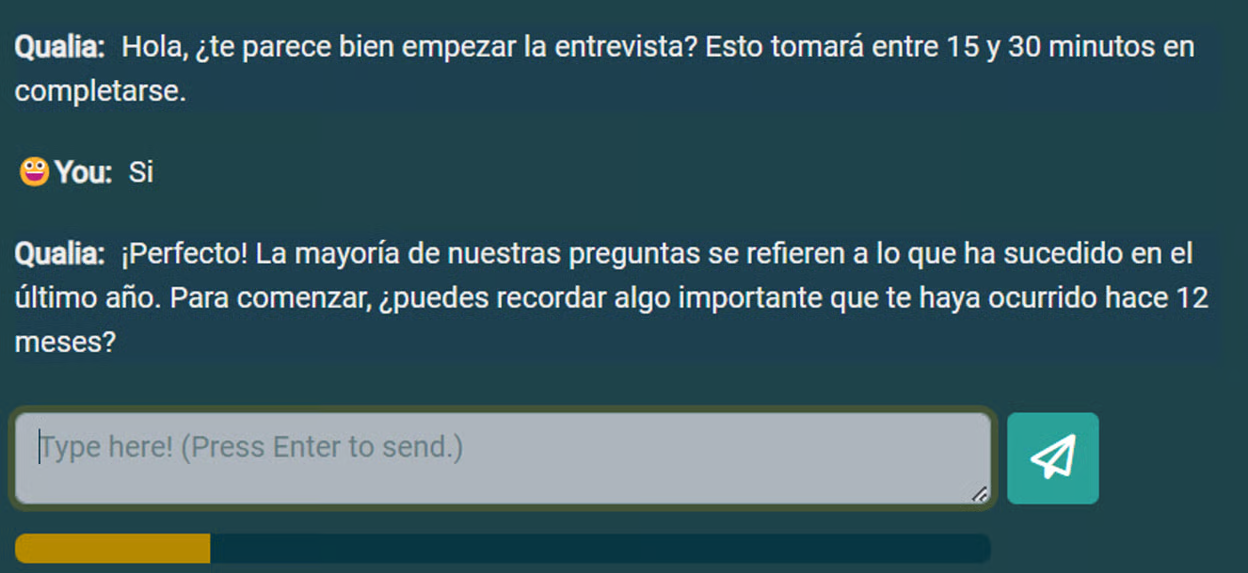
Automated Data Collection (Qualia): We designed a responsive, chat-based interview in Spanish using QuIP-style questions. Our AI interviewer, Qualia, powered by GPT-4o, was instructed to explore three key domains: educational experiences, professional development, and relationship dynamics. Out of 50 students invited, 32 completed the conversational interviews.
-
Radical Zero-Shot AI Coding: Once the interviews were completed, the transcripts were uploaded to Causal Map, and we used a "radical zero-shot" approach to code the data using GPT-4o. The AI was given no pre-defined codebook; instead, it was instructed to "invent" its own codes based purely on the students' narratives (in Spanish). This process identified 251 distinct causal links.
- Targeted Research Analysis: We used Causal Map's filtering tools to interrogate the data and answer specific research questions, such as "What is the immediate impact of gender discrimination?" and "What are the most mentioned causal factors?" We also used the "AI Answers" feature to generate summaries of the broader text independently of the causal coding.
Results#
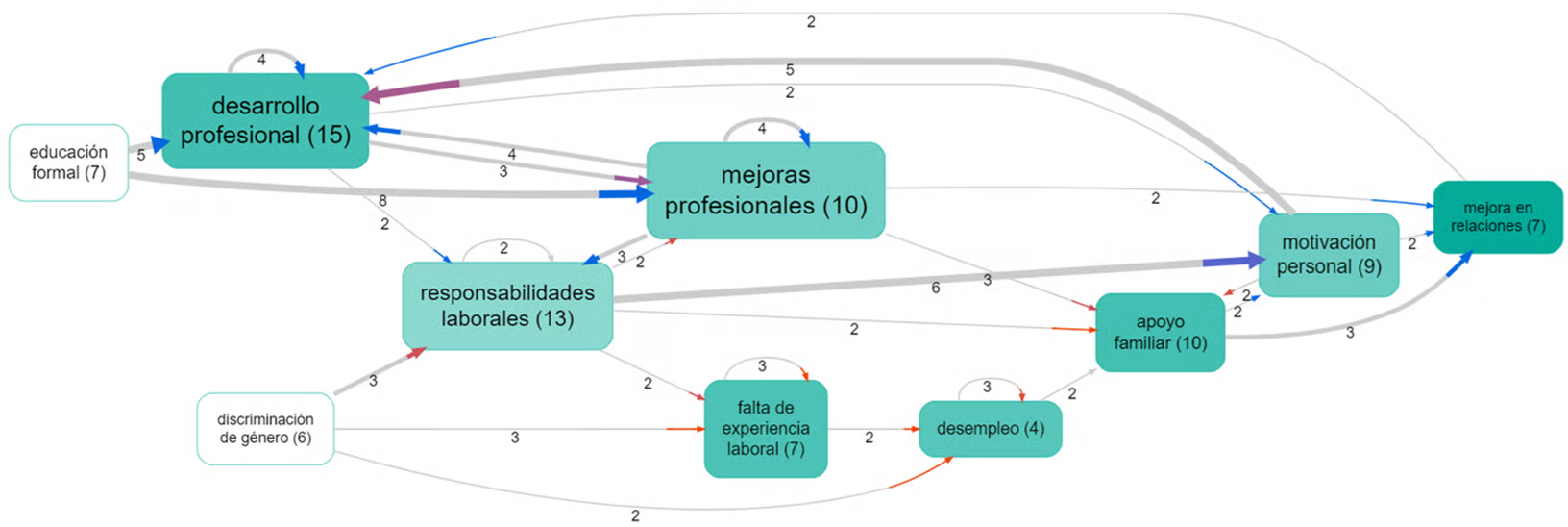
The project provided DuocUC with a visual, evidence-based understanding of the "causal network" surrounding gender discrimination in their STEM programmes.
- Sentiment-coded maps: We auto-coded the sentiment of every link, using blue arrows for positive contributions and red for negative ones, allowing the researchers to see exactly where the "friction points" were in the students' journeys.
- Sythesis: The workflow transformed 32 in-depth interviews into manageable causal maps, making it easy to identify the most frequent factors mentioned by respondents.
- Actionable insights: By filtering the maps, the team could isolate specific pathways of change, helping DuocUC to validate where their current interventions were working and where new support was needed.
See what Javiera has to say:
"The type of questions that were asked "what causes what", were equally linked to methodological innovation. The results were able to portray how gender barriers are intertwined in domains ranging from higher STEM education to the performance of new professionals and technicians once they enter the labour market, reaching deeper explanations and social impact.” — Javiera Cienfuegos (Senior Researcher, DuocUC)